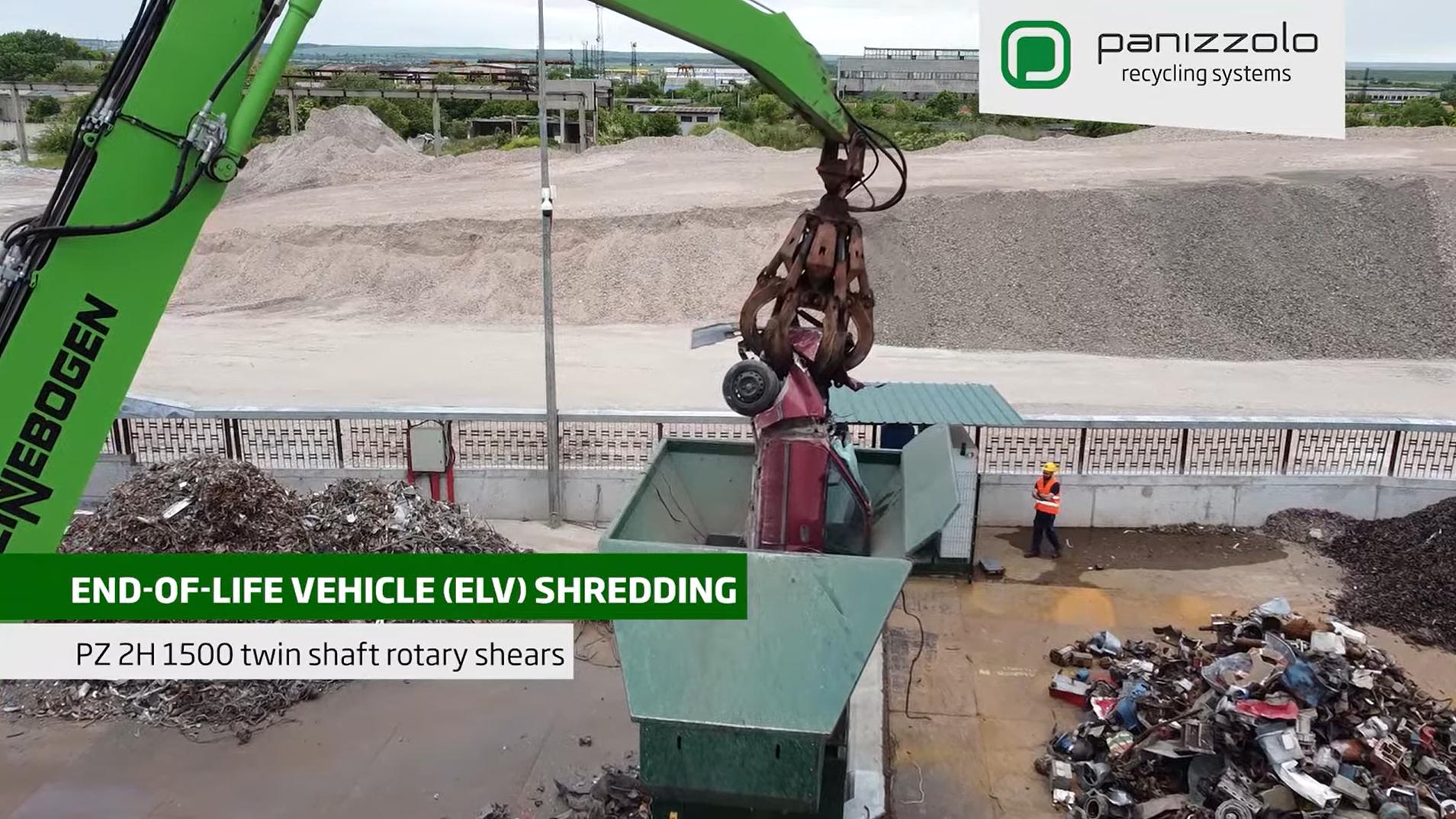


The Importance of shredding end-of-life vehicles
The end-of-life vehicle (ELV) sector stands at a vital crossroads of environmental responsibility, resource efficiency and regulatory compliance. As vehicles reach the end of their useful lives, the way we process and recycle them has large implications for sustainability, economics and circular-economy goals. In this article, we’ll explore why shredding ELVs is so important — and then how Panizzolo’s machinery, available through Machines on The Market in the UK and Ireland, offer a strong toolset to meet the challenge.
Why ELV shredding matters
1. Recovery of valuable resources
Every vehicle at end of life contains a mix of ferrous metals (e.g., steel), non-ferrous metals (aluminium, copper, brass), plastics, rubber, glass, and other materials. By shredding and sorting these vehicles, we can recover large quantities of secondary raw materials, reducing the need to mine or produce virgin materials and thereby saving energy and emissions.
2. Minimisation of waste and landfill use
Vehicles that aren’t properly processed turn into complex waste streams: plastics, rubber, foams, fabrics, glass, and residual fluids. Some of that ends up as what is called Automotive Shredder Residue (ASR). Without effective shredding and separation, large volumes of material may end up landfilled or incinerated — a waste both of resources and of potential value. As Panizzolo notes, vehicles at the end of their life cycle “represent an important source of secondary raw materials” but their “complex composition makes their treatment difficult and long in a profitable way.”
3. Compliance with environmental regulation and circular economy goals
Many countries and regions impose requirements on vehicle-producers or dismantlers to ensure that vehicles are processed in environmentally safe ways, that certain recycling or recovery targets are met, and that hazardous materials (such as fluids, batteries, air-conditioning refrigerants) are handled properly. Efficient shredding systems help meet these regulatory demands and support circular-economy ambitions (closing loops of material use).
4. Economic benefits
When the scrap metals and other materials from vehicles are recovered efficiently, there is significant economic value: revenue from secondary raw materials, savi ngs from reduced landfill/disposal costs, and improved profitability of recycling facilities. But this only works if processing is efficient, high-quality, and cost-effective.
5. Reducing environmental footprint of vehicles
If you follow the lifecycle of a vehicle from production through use to end-of-life, the final recycling stage matters: the more efficiently metals and other components are recovered, the lower the embodied energy that must be ‘disposed’ or wasted. The more we can re-introduce recycled metals into new vehicles (or other products), the lower the demand for raw material extraction and the associated environmental impacts.
6. Handling of the difficult “fluff” fraction (ASR)
One of the trickiest issues in the ELV chain is the so-called ASR – the automotive shredder residue. That includes glass, fibre, rubber, plastics, and still a heavy fraction of metals like iron, steel, copper and aluminium. Because it’s heterogeneous and contains small fractions of valuable metals mixed with low-value materials, it has historically been difficult to process profitably. Panizzolo emphasises that this “fluff” previously was “too complicated and wear-causing to be treated” but can now be brought into the End-of-Waste cycle thanks to advanced machinery.
Key challenges in ELV shredding
- Heterogeneous feed: Vehicles vary widely in make, model, size, materials used (e.g., aluminium vs steel-intensive), and in how they have been dismantled. This complicates the shredding and sorting flows.
- Hazardous materials: Before shredding, fluids (oil, coolant, brake fluid), refrigerants, batteries, airbags etc must be removed or handled. If not, shredding can pose safety or environmental risks.
- Wear and maintenance issues: The mechanical treatment of large, heavy, complex items places high demands on the equipment — from volumetric reduction to grinding, sorting, and refining.
- Quality of output: For recovered materials to be valuable (and sellable), they must meet purity and specification standards. Low-quality mixtures reduce value and limit re-use.
- Volume vs cost trade-offs: Processing large volumes efficiently requires heavy machinery, high throughput, and low downtime — but capital and operating costs must be kept under control for profitability.
Why shredding is a central step
Shredding is the primary step of physically breaking down the vehicle bodies, components, frames, and other materials into manageable sizes. This volumetric reduction enables subsequent sorting and refining steps: separating ferrous vs non-ferrous metals, plastics, rubber, etc. Without effective shredding, the downstream sorting suffers: slower throughput, lower recovery yields, higher waste, more wear and more manual labour.
How Panizzolo Recycling Machinery supports ELV shredding
Now that we’ve laid out the importance and the challenges, let’s look at how Panizzolo’s solutions apply specifically to the ELV sector.
Panizzolo is an Italian-based specialist in recycling plants and machinery — with solutions for ELV, scrap metals, aluminium, etc. Their product range highlights modular systems for ELV recycling: mechanical in-line treatment, low operating costs, centralised control software, modular plant design.
Modular ELV Recycling Plant
Panizzolo describe how their systems are modular and designed for mechanical and in-line treatment cycles:
- “Modular systems … you can always implement treatment technologies, obtaining the size and sorting degree most convenient for the company.”
- “Mechanical and in-line treatment cycles … streamline the process in terms of simplicity, costs and production results.”
- “Operating costs … are below the average on the market” thereby favouring productivity and profitability.
- “Treatment flexibility: machinery can receive different types and sizes of in-feed material” which is very relevant for ELVs given variability in vehicles.
This kind of plant supports the key needs of ELV recycling: high throughput, flexibility, cost-effective operation, and readiness for sorting/refining.
Pre-shredding and shredding technologies
One of the more recent innovations by Panizzolo is the “Kraken” pre-shredder series:
- The article “The New Kraken Series: Panizzolo’s Approach to Pre-Shredding” explains that the unit is designed for volumetric reduction of the most complex scrap (including ELVs). recyclind.com
- Features include a robust frame, 630 kW motor, 95-ton total weight, enabling processing of bulky items like ELVs and car bales (including engines and mechanical parts). recyclind.com
- It specifically improves the input flow to the hammer mills by tearing and reducing material in a single pass, thus optimising energy efficiency and wear-reduction downstream. recyclind.com
This shows how Panizzolo addresses the throughput and wear issues of ELV shredding: by optimizing the pre-shredding stage, feeding the shredders more uniformly, reducing blockages, and improving efficiency.
Grinding & refining of ASR / car-fluff
Panizzolo emphasises the treatment of ASR (automotive shredder residue) or “car-fluff” in its ELV plant offering:
- The plant includes an initial volumetric reduction (shredder) then a grinding (hammer‐mill) stage; depending on objectives, accessories are fitted to recover ferrous and non-ferrous metals.
- They describe “refining plants” specifically for ASR/car-fluff: “The refiner mills are specifically patented to machine high percentages of steels, plastics and wear-causing inerts, profitably recovering the copper, brass and aluminium granules.”
- They frame this as enabling an End-of-Waste treatment cycle: i.e., converting the waste fraction into a secondary raw material.
Given that ASR treatment is one of the big bottlenecks for ELV recycling, Panizzolo’s emphasis on this stage is a major advantage: better metal recovery, better value generation, and avoiding landfill of high‐value components.
Centralised control & efficiency
One of the enabling features of Panizzolo’s plants is the software/control side:
- “Centralised management: Panizzolo software guarantees the centralised control of all the technologies on the plant. It autonomously manages the parameters, interfacing with operators through a specific touch screen.”
- The advantage: improved operational efficiency, less labour/time waste, optimized throughput.
Flexibility to handle variable input
Because ELVs come in many shapes and conditions (small cars, large SUVs, light commercial vehicles, mixed steel/aluminium construction, hybrid/electric vehicles), the flexibility in feed size and type is important.
- Panizzolo notes: “The machinery can receive different types and sizes of infeed material, depending on the scrap and on customer requirements. This flexibility is also made possible thanks to specific patented elements.”
- On the ELV material page: “Automation of the recycling operations … reduces manual labour and processing times and allows for the proper sorting of all of the components.”
This flexibility means a facility can handle changing ELV feed streams (for example as vehicle fleets evolve) and adapt the processing accordingly, making the investment more future-proof.
Lower operating costs and improved ROI
Panizzolo advise that their processes result in “ow management costs and below market average operating costs. For ELV recycling facilities, controlling costs (energy consumption, wear parts, labour, downtime) is critical given the margin pressure. By using efficient machinery, integrated software, modular systems, and effectively treating ASR and refining the outputs, the ROI improves.
Putting it together: Why this matters for you (if you operate or invest in an ELV recycling facility)
If you’re working in the end-of-life vehicle recycling business (or considering investing in one), here are the key take-aways and how Panizzolo’s offering aligns:
- Maximise metal recovery: Ensure your facility recovers as much ferrous and non-ferrous metal as possible, because that’s where significant value lies. Panizzolo’s systems (hammer mills, pre-shredders, refining plants) are designed to enhance metal recovery, including recovery from the ASR fraction.
- Improve throughput and reduce bottlenecks: Vehicle feed is bulky and variable. Pre-shredding (Kraken series) and modular design help maintain steady flow, reduce downtime and mechanical stress, and keep productivity high.
- Enhance purity and quality of output: Secondary raw materials must be clean enough to be marketable. Proper mechanical treatment and sorting achieve higher quality outputs and better market value.
- Reduce waste, landfill, environmental risk: A well-designed plant will minimise leftover refuse, reduce disposal cost/risk, and align with regulatory and corporate sustainability goals. Panizzolo’s systems incorporate in-line treatment and refining of ASR.
- Manage costs and improve profitability: Machinery that is efficient, reliable, modular and integrated (software control, automation) will reduce operating cost, labour cost, maintenance cost, and thus improve ROI.
- Future-proof operations: Since vehicle materials and designs evolve (e.g., more aluminium, electric vehicles, mixed materials), equipment that can adapt to different feed and sorting requirements is advantageous — and Panizzolo emphasises flexibility.
- Regulatory and environmental compliance: By using mechanical, in-line, modular systems, the operator is better positioned to meet increasing regulation around ELV processing, waste handling, and circular-economy mandates.
Challenges & considerations when deploying Panizzolo systems
While the offering is strong, a few caveats or considerations are worth noting:
- Capital investment: Advanced shredding/grinding/refining systems are significant capital investments. You must assess throughput, pay-back, and scale accordingly.
- Site infrastructure and feed logistics: The size, weight and complexity of ELV feed (vehicles, engines, etc) means you must have appropriate handling/logistics, pre-treatment (fluids, batteries removal), feed preparation, and space.
- Maintenance and wear: Although Panizzolo emphasises durability, heavy-duty applications (ELVs are harsh feed) mean you will encounter high wear. Ensure you budget for parts, maintenance, downtime planning.
- Market for outputs: Recovering metals is one thing; selling them (especially non-ferrous fractions, refined outputs) in the right markets is another. Ensure you have end-markets.
- Training and integration: Having modular machinery plus control software is valuable, but you’ll need skilled staff to operate, maintain, optimise.
- ASR treatment and residual disposal: Even with advanced refining, a portion of ASR may remain. Plan for this and ensure you comply with waste-disposal/regulatory obligations.
- Feed variability risk: Vehicle types, materials, regulations change (e.g., more electrified vehicles with batteries etc). Ensure the plant layout allows for future adaptation. Panizzolo emphasises flexibility—but you must plan it.
- Energy and utilities: High-throughput mechanical systems use significant energy. Operating cost optimisation (as Panizzolo claims) must be realised in practice.
Shredding and processing end-of-life vehicles is not simply about disposal — it’s about resource recovery, operational efficiency, compliance and turning what was once waste into value. In the broader context of sustainability and the circular economy, ELV recycling plays a significant role.
The machinery and plant solutions from Panizzolo provide a compelling path forward: modular, flexible, efficient systems that handle the key stages (pre-shredding, grinding, sorting, refining), reduce operating cost, and improve recovery of metals — including the tricky ASR fraction. For any organisation engaged in ELV recycling, selecting the right equipment is a strategic decision: one that impacts productivity, profitability and environmental performance.
To find out more and to discover how Panizzolo machinery can help support and grow your business, get in touch today for expert, bespoke advice.
WhatsApp: +44 7787 411485
E-mail: marketing@machinesonthemarket.com
www.machinesonthemarket.com